
The curtain is coming down on @caribsurf.com. After nearly three decades of connecting the region, the pioneering Caribbean-wide email service will be permanently turned off on 30th September 2026, at which point all accounts and data will be deleted.
In the mid-1990s, the internet was beginning its transition from a niche tool for academics, researchers and technical specialists into an everyday, household resource, that early adopters could access from their homes.
In Barbados, the telecommunications market was dominated by Cable & Wireless, operating through its local entities, Barbados Telephone Company Limited (BARTEL) and Barbados External Telecommunications Limited (BET).

BARTEL was originally established as a standalone public telephone company in 1903, with the Telephone and General Trust Company as its majority shareholder. The company was subsequently acquired by Cable & Wireless. Cable & Wireless operated BARTEL for domestic telecommunications and BET for international services, before eventually consolidating the two under the single Cable & Wireless brand in 2002.
It was against this backdrop that in 1996 Caribsurf was launched as Cable & Wireless’ pioneering internet service provider (ISP) brand across its Caribbean markets.
The late 1990s: The Dawn of Dial-Up
For the earliest digital adopters in Barbados, Caribsurf was the gateway to the World Wide Web.
During the late 1990s, getting online required three things: a telephone landline, a computer and a dial-up modem. Early modems typically connected at 33.6 Kbps, with later models reaching the dizzying speed of 56 Kbps.

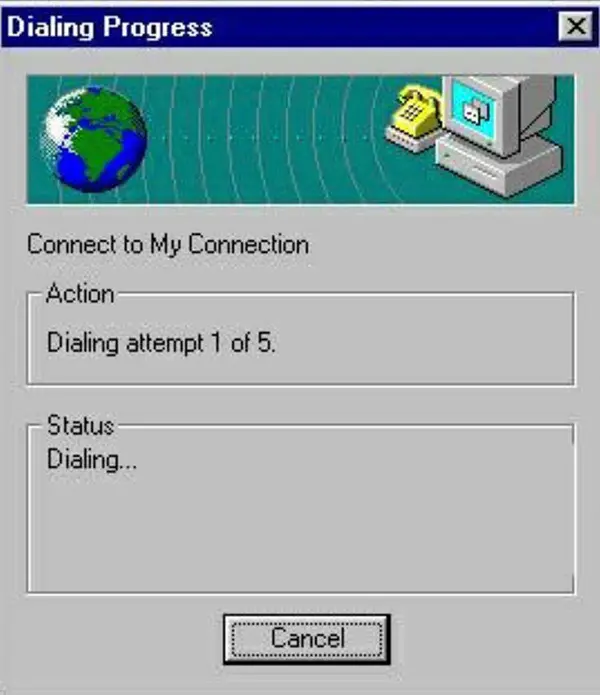
Do you remember those dial-up days? You knew you were about to go online when the dial-up modem started its ritual.
First came the telephone dialling tones, then a burst of electronic beeps and bips, followed by the unmistakable squeal, squawk, chirp, warble, screech and squelch of the modem handshake. Bleep-bloop… chirrrp… krrrreeee… squawk… shhhrrrkkk… piiiiing!
It sounded almost as though two machines were arguing down the telephone line before finally settling into silence. Then you were connected to Caribsurf and, for the next few minutes, the world was at your fingertips for access to email and the new fangled world wide web.
In those early days internet access was an expensive luxury. Internet dial-up was billed by the minute on top of your monthly telephone subscription fees! Every minute spent browsing was another minute on the clock.
Compare that with today. My home internet connection is delivered over fibre, rated at 300 Mbps, and is on 24 hours a day. That is Mbps rather than Kbps — making it more than 5,000 times faster than a 56 Kbps dial-up connection from the late 1990s!
Your First @caribsurf.com Email Address
Every Caribsurf subscription included a master username, which also provided an @caribsurf.com email address.
For those of you who were there, having a @caribsurf.com email address was more than simply having an email account. It was a sign that you were connected and a small badge of early technological literacy in Barbados.
At a time when relatively few people had access to the internet, a @caribsurf.com address was a status symbol.
The Caribsurf Portal
In those pioneering early days Caribsurf also operated a localised web directory at https://www.caribsurf.com. Before Google and modern search engines became the starting point for almost everything online, portals such as Caribsurf provided a convenient homepage for internet users.
The site brought together local news, weather, international sports and information about Barbados, along with early directories of local businesses and other useful resources.
For many Bajans, it was one of their first regular windows onto the wider – world wide web.
From Dial-Up to Broadband
As telecommunications infrastructure developed, Caribsurf began moving customers from 56 Kbps dial-up to ADSL broadband, marketed as Caribsurf High Speed.
The change from dial-up to ADSL was revolutionary.
Instead of having to use a dial-up connector and waiting for the modem to negotiate a connection every time you wanted to go online, broadband provided a permanent “always-on” internet connection.
Crucially, ADSL used the existing telephone infrastructure. A small microfilter split the telephone line into separate frequencies, allowing voice calls and internet data to travel simultaneously.
No more disconnecting the internet to make a telephone call. No more shouting:“Who’s on the internet? I need the phone!” And no more family arguments over who got to use the telephone and who got to use the computer.
The rapid expansion of internet access helped Barbados achieve remarkably high levels of internet penetration for a developing country during this period. The Caribsurf portal also expanded, providing regional classifieds, tourism information and early Caribbean chatrooms.
At the time, Cable & Wireless still held an effective monopoly over telecommunications in Barbados.
The 2001 Breakthrough: Flat-Rate Internet
In 2001, Caribsurf introduced what was a major change for local internet users — flat-rate internet access.
Instead of paying according to how many minutes you spent online, customers could pay a fixed monthly fee and browse the web and send emails without constantly watching the clock.
For anyone who remembers dial-up internet, this was a profound change.
The internet suddenly became something you could use more freely rather than something you had to ration.
The move helped fuel a rapid increase in internet use across Barbados and contributed to the island becoming one of the most connected nations in the Caribbean.
The Mid-2000s: The Shift to Broadband
As the Barbadian telecommunications market liberalised between 2002 and 2005, the landscape shifted from a monopoly held by Cable & Wireless to a more competitive environment. New ISPs such as Sunbeach and FreeMotion (later acquired by TeleBarbados) were prominent early entrants that emerged to challenge Cable & Wireless.
Caribsurf responded by continuing its move towards high-speed broadband DSL services.
2008–2015: Corporate Rebranding
By the late 2000s, the telecommunications landscape was changing rapidly.
In 2008, Cable & Wireless rebranded its Caribbean operations as LIME, an acronym for Landline, Internet, Mobile and Entertainment.
The Caribsurf brand was gradually phased out as an active internet service, but the @caribsurf.com email service remained.
That decision would ultimately give the Caribsurf name a life far beyond its original internet service.
Thousands of Bajans have spent years giving out their @caribsurf.com email addresses to friends, relatives, businesses and organisations. Changing an email address used for years – sometimes decades – is not something people necessarily wanted to do.
The old email accounts therefore remained part of the telecommunications landscape long after Caribsurf itself had disappeared as a consumer internet brand.
In 2015, Cable & Wireless/LIME was acquired by Columbus Communications, bringing the operation into the FLOW network.
Even as broadband evolved and fibre-optic connectivity increasingly replaced older technologies, the legacy Caribsurf email infrastructure continued to serve users who had retained their original @caribsurf.com addresses.
2026: The End of an Era – the closing of all @caribsurf accounts
After almost three decades, the story of Caribsurf is finally coming to an end. In addition to the @caribsurf.com, the domain variants in St. Vincent @vincysurf.com, Antigua and Barbuda @candw.ag, Montserrat @candw.ms and Cayman @candw.ky are also being shut-down.
This decommissioning will allow FLOW to redirect engineering resources toward its core high-speed connectivity services and the development of advanced digital solutions.
Crucial Deadlines – Time is Running Out
FLOW first announced plans to phase out its legacy email services in early 2026, and final deadlines have now been established for the legacy @caribsurf.com email platform and its regional variants.
@caribsurf.com subscribers must act immediately, as service restrictions will roll out in phases leading up to the final deletion:
- 31 August 2026: You will no longer be able to send emails from @caribsurf.com.
- 15 September 2026: You will no longer be able to receive emails at @caribsurf.com.
- 30 September 2026: All @caribsurf.com accounts and data will be permanently deleted.
The closure marks the end of a remarkable chapter in Barbados’ technological and cultural history.
What @caribsurf.com Users Need to Do Next
Anyone still using a @caribsurf.com email address should urgently move to an alternative provider. Major email services offer reliable webmail that can be accessed from computers, tablets and smartphones.
Possible alternatives include:
- Gmail: Over 1.8 billion users.
- iCloud: Over 950 million users.
- Outlook: Over 400 million users.
- Yahoo Mail: Over 225 million users.
- Proton Mail: Over 100 million users.
The tedious part is not creating the new account – it is updating your digital footprint.
Remember to change your email address with family and friends, utility companies, banks, insurance providers, online shopping accounts, government services and social-media accounts such as Facebook. Don’t forget: subscriptions, mailing lists and any websites where your @caribsurf.com address is used for password recovery.
Nostalgia of the Dial-Up Era
For those who grew up alongside the early Caribbean internet, a @caribsurf.com address was more than a communication tool. It served as a badge of early adoption in Barbados.
It evokes memories of dial-up modems tying up the household telephone line, the iconic screeching sounds of a modem handshake, and the patient wait for web pages to load as a strange new frontier called the World Wide Web slowly materialised.
The 2013 Turning Point
The structural transformation of the Caribsurf email service began in September 2013, when LIME migrated its Caribsurf customers’ email to Google’s Google Apps mail. From that point onward, @caribsurf.com accounts ceased to operate as a purely homegrown, locally hosted email system. Instead, the individual mailboxes were moved onto Google’s global cloud infrastructure on space leased from Google.
The transition was far from seamless for subscribers, triggering widespread login disruptions, dropped messages, disconnected Outlook clients, password failures, and wiped contact lists. To keep the service functioning technical workarounds had to be implemented. Engineers set-up legacy routing servers to serve as an invisible data bridge, quietly translating outdated dial-up era server settings to Google’s cloud-based platform. This allowed subscribers to continue using their familiar @caribsurf.com email addresses despite the fundamental change in the underlying technology.
Despite the disruption, the migration moved @caribsurf.com email onto Google’s infrastructure. The Caribsurf identity survived, even though the technology behind it had fundamentally changed.
Thirteen years later, the legacy routing servers that served as an invisible data bridge to Google have reached the end of their operational life. FLOW has determined that these ageing systems will not be replaced. As the remaining legacy routing and forwarding infrastructure is retired, the long-standing connection between the Caribsurf email service and its Google-hosted environment will finally come to an end.
The consequence for users is definitive. As @caribsurf.com accounts are hosted on Google’s cloud infrastructure when the service is terminated Google is legally obligated to permanently purge every email, folder, and archived contact stored under the @caribsurf.com banner. This is set to happen on 30th September 2026, drawing a final curtain on the Caribsurf era.
The End of @caribsurf.com
The impending closure represents more than the retirement of an old email service. It marks the disappearance of one of the last surviving digital identities from Barbados’ early consumer internet era.
For those of you who have used the same @caribsurf.com address for decades, the loss is particularly significant. An email address that may have appeared on business cards, letterheads, family correspondence, bills and online accounts is suddenly becoming part of history.
And with that, one of the last surviving pieces of Barbados’s early internet era will disappear.
The days of @aribsurf.com may be ending, but for those who remember them, the sound of that modem connecting will probably never be forgotten: Bleep… beep… chirrrp… screeeeech… squawk… krrrreeee… psssst… then silence… Connected.
Epilogue
What’s next in terms of internet delivery in Barbados?
Most of Barbados’ fibre cable infrastructure is hung from old, mostly neglected telegraph poles. Given the sate of repair of those poles, if a bad storm or a hurricane was to strike Barbados it would probably take out most of the overhead fibre network!
Going forward the next iteration is probably 5G or 6G mobile technology or the use of low-earth orbit (LEO) satellite network. Both the mobile and LEO options are cable free. The Starlink LEO network is readily available in Barbados. The Chinese LEOs are still in their infancy but are quickly catching up on Starlink, just like BYD surpassed Tesla to become the world’s largest seller of electric vehicles, driven by massive internal Chinese demand and subsidies from China for strategic technology investment and for aggressive overseas roll-out to help grow demand and lower unit prices. Watch this space…
If you have a @caribsurf.com email address and subscribe to BajanThings.com and would like to continue to subscribe, please use the link below add your new email address and click on: Subscribe.
Your new email address will be automatically added to the BajanThings Subscriber list, so whenever there is new content added to BajanThings you will receive a notification email informing you of the update.
Alternatively please go to the BajanThings Subscribe / Unsubscribe page and add your new email address and click on: Subscribe.
There is no need to Unsubscibe your old @caribsurf.com email. BajanThings will manually purge the BajanThings subscription email list in September of all @caribsurf.com email addresses so when we make future posts and email you – we will not get penalised for failed @caribsurf.com emails by the global email hosts!
We’d love to hear your @caribsurf.com stories – please leave them in the comments section below.